
Accreditation is one of the ways in which the BCHS publicly demonstrates accountability and our ongoing commitment to quality improvement to our patients and community.
Accountability
The Brant Community Healthcare System is dedicated to being accountable and transparent to the community that we serve. We primarily remain accountable through our Board of Directors. However, there are a number of other ways we ensure that we act in an accountable, transparent manner in all our interactions.
| Accreditation | Annual Reports | Public Reporting | Quality Improvement Plans | Financial Accountability | Energy Conservation and Demand Management |

Accreditation
BCHS is proud to have been Accredited with Exemplary Standing by Accreditation Canada in November 2023.
Accreditation is a continually evolving process, which enables us to evaluate and improve the quality of our services through peer review and self-assessment. It accurately assesses how our services meet national standards of care and quality. Accreditation Canada has deemed that in order to have quality care, you must have safe care. BCHS has been successfully accredited in 2009, 2011, 2015, 2019, and 2023.

Annual Reports
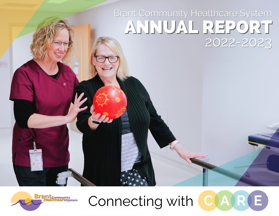
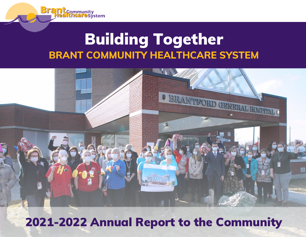
We are pleased to share the 2024-2025 Annual Report to the Community. This report showcases the meaningful progress we’ve made across key initiatives. As we reflect on the past year, the theme of this year’s annual report, “United in Care,” captures the spirit of teamwork and shared purpose driving our efforts to deliver exceptional care.

Public Reporting
Brant Community Healthcare System is committed to providing exceptional, high-quality care, for all patients. As part of our commitment to quality and patient safety, we continuously monitor the quality of care we provide using a number of evidence-based patient safety indicators. These indicators are standardized provincially and/or nationally as defined by the Ministry of Health and Long-Term Care, the Institute for Healthcare Improvement, the Canadian Institute for Health Information and Accreditation Canada.
Clostridium Difficile Infection (CDI) rate
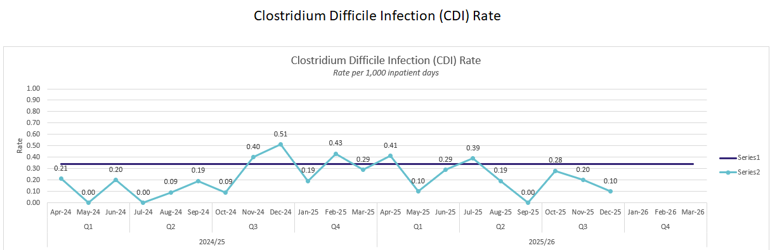
| Indicator Name: | Hospital-Acquired Clostridium Difficile Infection (CDI) |
| Indicator Description: | The indicator measures the incidence rate of hospital acquired Clostridium difficile infection (CDI) per 1,000 inpatient days. |
| Performance Direction: | A lower rate is associated with better performance. |
| Quality Dimension: | Safe |
| Indicator Type: | Outcome |
| More Information: | Health Quality Ontario: C. Difficile Infections Acquired in Hospital |
Methicillin-Resistant Staphylococcus Aureus (MRSA) rate
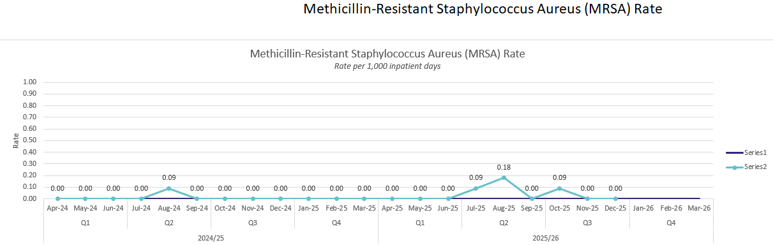
| Indicator Name: | New hospital-associated methicillin resistant staphylococcus aureus (MRSA) bacteremia rate per 1,000 patient days |
| Indicator Description: | This rate represents the incidence rate of nosocomial MRSA infection associated with the reporting facility per 1,000 inpatient days. |
| Performance Direction: | A lower rate is associated with better performance. |
| Quality Dimension: | Safe |
| Indicator Type: | Outcome |
| More Information: | Health Quality Ontario: Hospital-associated methicillin resistant staphylococcus aureus (MRSA) |
Vancomycin-Resistant Enterococci (VRE) rate
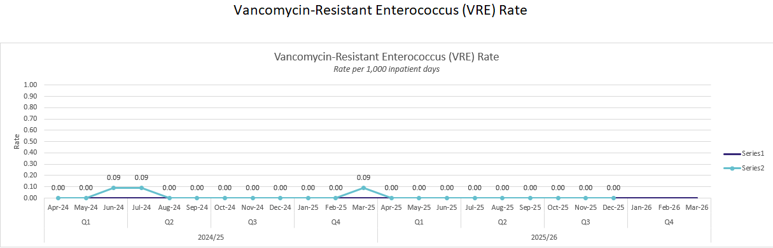
| Indicator Name: | New hospital-associated vancomycin resistant enterococcus (VRE) bacteremia rate per 1,000 patient days |
| Indicator Description: | This rate represents the incidence rate of nosocomial VRE infection associated with the reporting facility per 1,000 inpatient days. |
| Performance Direction: | A lower rate is associated with better performance. |
| Quality Dimension: | Safe |
| Indicator Type: | Outcome |
| More Information: | Health Quality Ontario: Hospital-associated vancomycin resistant enterococcus (VRE) |
Central Line-Associated Primary Blood Stream Infection (CLI) rate
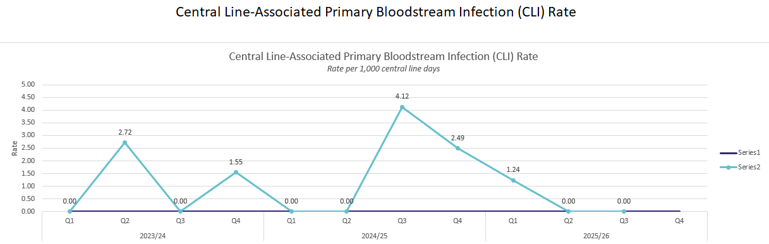
| Indicator Name: | Central Line-Associated Primary Blood Stream Infection (CLI) Rate |
| Indicator Description: | The indicator measures the number of intensive care unit (ICU) patients with new central line-associated primary blood stream infection per 1,000 central line days. |
| Performance Direction: | A lower rate is associated with better performance. |
| Quality Dimension: | Safe |
| Indicator Type: | Outcome |
| More Information: | Health Quality Ontario: Central Line-Associated Primary Blood Stream Infection |
Ventilator-Associated Pneumonia (VAP) rate
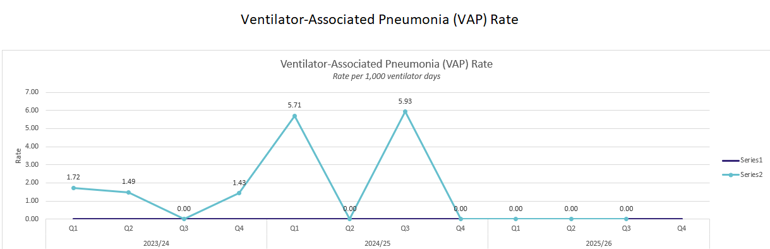
| Indicator Name: | Ventilator-associated Pneumonia (VAP) Rate |
| Indicator Description: | This indicator measures the number of ICU patients with ventilator-associated pneumonia (VAP) per 1,000 ventilator days. |
| Performance Direction: | A lower rate is associated with better performance. |
| Quality Dimension: | Safe |
| Indicator Type: | Outcome |
| More Information: | Health Quality Ontario: Ventilator-associated Pneumonia (VAP) |
Surgical Site Infection (SSI) Prevention rate
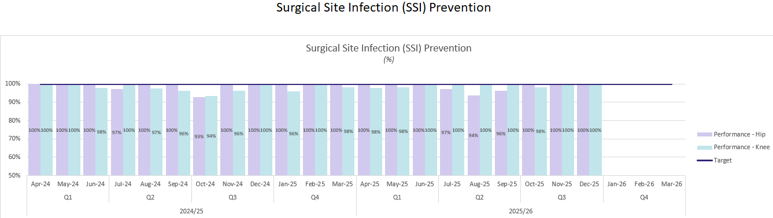
| Indicator Name: | Surgical Site Infection (SSI) Prevention (Hip and Knee Replacement) |
| Indicator Description: | This indicator measures the percentage (%) of total primary hip/knee replacement surgical patients with antibiotic administration that starts an appropriate time prior to skin incision and is fully infused before the surgery begins. |
| Performance Direction: | A higher percentage is associated with better performance. |
| Quality Dimension: | Safe |
| Indicator Type: | Process |
| More Information: | Health Quality Ontario: Surgical Site Infection (SSI) Prevention |
Surgical Safety Checklist (SSC) compliance
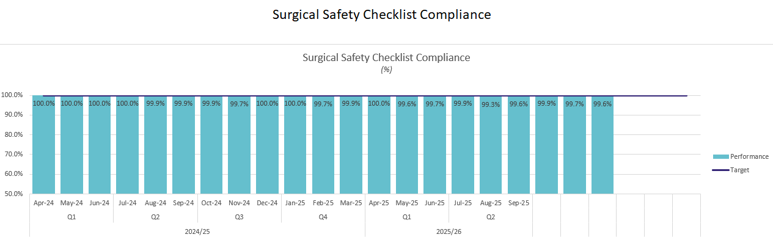
| Indicator Name: | Surgical Safety Checklist Compliance. |
| Indicator Description: | This indicator measures the percentage (%) of surgeries in which a surgical safety checklist was used. The surgical safety checklist is considered to be completed when the designated checklist coordinator confirms that surgical team members have implemented and or addressed all of the necessary tasks and items in each of the three phrases, ‘briefing’, ‘time out’ and ‘debriefing’, of the checklist. |
| Performance Direction: | A higher percentage is associated with better performance. |
| Quality Dimension: | Safe |
| Indicator Type: | Process |
| More Information: | Health Quality Ontario: Surgical Safety Checklist |
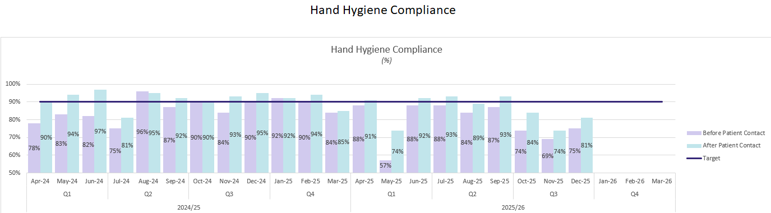
| Indicator Name: | Hand hygiene compliance among health care providers. |
| Indicator Description: | This indicator measures the percentage of hand hygiene compliance by health care providers before and after initial patient or patient environment contact. |
| Performance Direction: | A higher percentage is associated with better performance. |
| Quality Dimension: | Safe |
| Indicator Type: | Process |
| More Information: | Health Quality Ontario: Hand Hygiene Compliance |
Hospital-Standardized Mortality Ratio (HSMR)
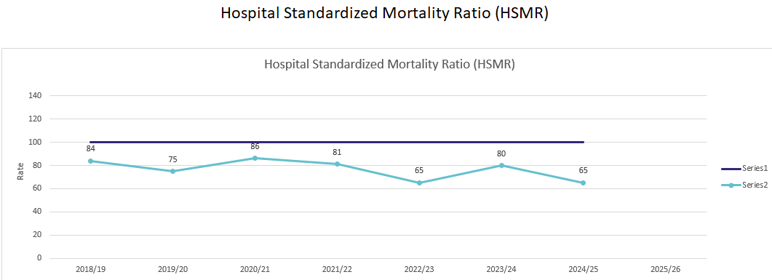
| Indicator Name: | Hospital Standardized Mortality Ratio (HSMR) |
| Indicator Description: | HSMR is a ratio of the actual number of in-hospital deaths in a region or hospital to the number that would have been expected based on the types of patients a region or hospital treats. |
| Performance Direction: | A lower ratio is associated with better performance. |
| Quality Dimension: | Effective, Safe |
| Indicator Type: | Outcome |
| More Information: | Canadian Institute for Health Information: Hospital Standardized Mortality Ratio (HSMR). |
Quality Improvement Plan (QIP)
Providing high-quality and safe care for our patients is a top priority for Brant Community Healthcare System. Each year we share our Quality Improvement Plan that outlines the goals and action plans we are taking in the year ahead to ensure each and every patient and their family have a good experience while in our care. Of significant note in our plan this year is our decision to ensure we have at least one goal with each of Health Quality Ontario's dimensions of quality.
Financial Accountability
At Brant Community Healthcare System, we’re committed to being open and transparent around the use of our hospital’s financial resources. This section includes information about finances at BCHS, including financial statements and executive compensation.
Energy Conservation and Demand Management
The Ontario Government is committed to helping public agencies better understand and manage their energy consumption. As part of this commitment, Ontario Regulation 507/18 under the Electricity Act requires each public agency, including healthcare systems, to report energy consumption and greenhouse gas (GHG) emissions annually, to implement an Energy Conservation and Demand Management (ECDM) Plan, and to update its ECDM Plan every five years.
Brant Community Healthcare System is committed to the ECDM Plan outlined in this document to reduce its environmental impact. This ECDM Plan pertains to the Brantford General Hospital (BGH) and The Willett Hospital (TWH) at Brant Community Healthcare System and addresses the following objectives.
- Baseline performance: To document previous and current energy and GHG performance.
- Energy conservation measures (ECMs): To document previous, current and proposed ECMs.
- Energy and greenhouse gas (GHG) plan: To establish 5-year energy and GHG performance targets and develop a road map to achieve those targets.
Contact Us
The Brantford General
200 Terrace Hill Street
Brantford, ON
N3R 1G9
519-751-5544
The Willett, Paris
238 Grand River St. North
Paris, ON
N3L 2N7
519-442-2251
Support the BCHS Foundation
The BCHS Foundation is committed to raising critical funds to support the top priority needs of the Brantford General Hospital and the Willett Urgent Care Centre.